
The goal of this project was to create three unique magazine spreads based on the life and work of Saul Bass, one feature spread and two article spreads.


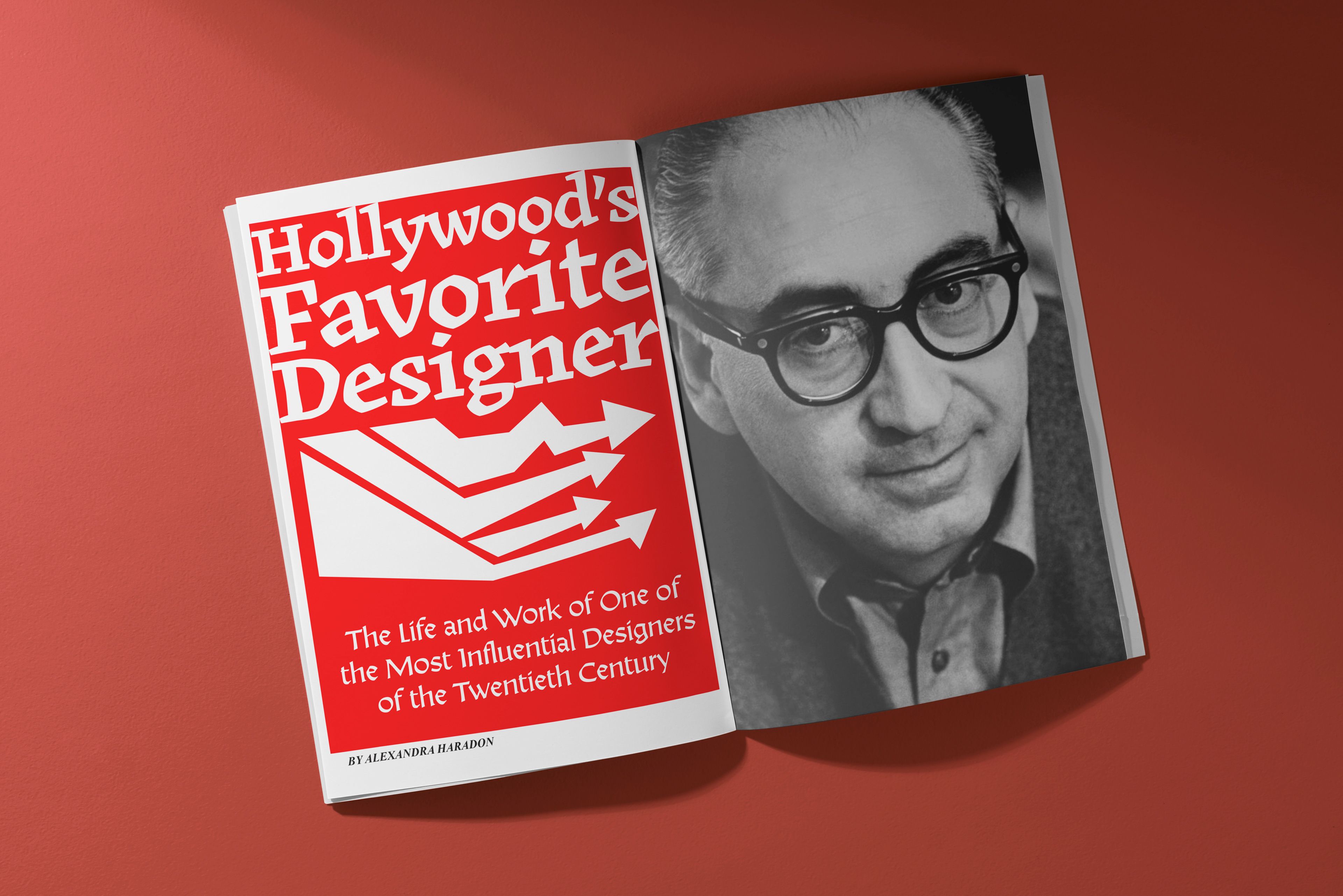




Hollywood’s Favorite Designer
Saul Bass was born on May 8, 1920, to a family of Jewish immigrants hailing from Eastern Europe. Raised in the Bronx, Bass would attend and graduate from James Monroe High School in the 1930s. In contrast to many young artists of the time, Bass’ parents fully supported his passion for art, and at age 16, Bass managed to secure a fellowship to the Art Students League in Manhattan.
Due to the economic strain of the Great Depression, Bass would have to take work in an advertising agency, where he designed film posters, whilst simultaneously attending night classes at Brooklyn College to study design. During his time at Brooklyn College, Bass developed a friendship with György Kepes, a well-known Hungarian painter, photographer, and designer. The high emphasis Kepes placed on pushing the abstraction of a design had a clear influence on Bass’ later work.
In 1946, Bass would move to Los Angeles in order to find more work designing promotional work for Hollywood productions. His big break came when he designed the poster for Otto Preminger’s Carmen Jones (1954), which earned him recognition and caused him to see the creative potential of title sequences. Soon after, he would create the title sequence and poster for Preminger’s The Man with the Golden Arm (1955). This success would result in him being sought out by other well-known directors, such as Alfred Hitchcock. Bass became a frequent collaborator with Preminger, whom he would work on eleven more films with, and would work on three Hitchcock films altogether.
In 1956, Saul Bass would establish his own design practice, Saul Bass & Associates. Around this time, he would meet Elaine Makatura. Soon after the pair collaborated on the title sequence for the film Spartacus, which Elaine co-directed and produced, they were married. From then on, a majority of Saul Bass’ work would be made in close collaboration with Elaine Bass.
In the mid-1960s, the couple would shift their focus away from main titles, instead working to create short films and raise their two children. Of course, Bass would still create a number of iconic designs during this time period. These included the poster for Stanley Kubrick’s adaptation of The Shining (1980), the 1978 trefoil logo for The Girl Scouts of America, and the original AT&T logo from 1968.
Throughout his career, Saul Bass predominantly created designs for the film industry, designing posters, promotional pieces, and title sequences for different films. He also worked in advertising, designing corporate logos for a variety of different companies. A majority of these designs were specifically created for the mediums of print or film.
The visual and conceptual style of these pieces, and Bass’ work overall, can best be described as eye-catching. While Bass’ pieces can vary in their tones, purposes, and themes, they are united by the use of high contrast visuals, bright and vibrant colors, and simplified, symbolic forms. These design features force the viewer to pay attention to his work. These factors, particularly the simplified forms, also have the added benefit of communicating the deeper meanings of Bass’ work to the average viewer while still having an element of abstraction that keeps them interested.
When looking into the life and work of Saul Bass, there is one aspect of his life that is sometimes overlooked in favor of his admittedly iconic posters. Not only was he an incredibly successful designer, but an award-winning filmmaker. In 1968, Saul Bass, alongside Elaine Bass, created the short film documentary Why Man Creates, which attempts to explore the nature of creativity. The film went on to win the 1969 Academy Award for Best Documentary Short Film. While Why Man Creates is the most well-known of Bass’ short films, he worked on several others, usually in collaboration with Elaine Bass.
Of course, Saul Bass and his work were both heavily influenced by the world and people around him. As previously noted, Bass’ relationships with Elaine Bass, whom he frequently collaborated with, and György Kepes, whom he studied under, greatly impacted how he approached design. The influence of the modernist and cubist movements in art is also apparent in much of Bass’ designs. Additionally, the duration of his career just so happens to align almost perfectly with one of the most well-known international conflicts of the twentieth century, the Cold War between the U.S and the Soviet Union. This was a period of intense paranoia for the American public, as nuclear panic and McCarthyism swept the nation into a frenzy. Furthermore, the social upheaval that characterized 1960s America with the rise of movements such as Second Wave Feminism, the Anti-War Movement, and the Civil Rights Movement, would result in a growing distrust of the U.S government. This might offer a bit of context to the uncomfortable and somewhat jarring tone found in many of Bass’s designs.


